A VIP brand experience is a customized, exclusive engagement that delivers privileged access and personal attention to a brand's highest-value customers, going far beyond standard interactions to build loyalty and emotional connection. Known formally in marketing circles as premium customer experience design, the VIP brand experience spans every touchpoint a brand controls: digital communications, physical environments, service interactions, and product access. Brands like Sephora, Porsche, and Net-a-Porter have built entire loyalty architectures around this concept. The business case is direct. When customers feel genuinely recognized, they spend more, advocate louder, and stay longer. This guide breaks down what defines a VIP experience, how it fits within your broader brand strategy, and how to build one that actually delivers measurable results.
What is VIP brand experience and what defines it?
A VIP brand experience is the sum of brand interactions tailored to feel exclusive and privileged for a selected high-value audience. That definition matters because it draws a clear line between a VIP program and a generic loyalty scheme. The difference is not just the perks. It is the deliberate design of every interaction to communicate: you are not like everyone else here.
The core components that define a true VIP experience are:
- Exclusivity. Gated access, limited availability, and invitation-only moments that cannot be purchased by the general public.
- Personal attention. Dedicated associates, individualized communications, and service that reflects knowledge of the specific customer's preferences and history.
- Experiential benefits over discounts. Early product access is preferred over a 20% discount in well-designed VIP loyalty programs. This is the clearest signal that VIP customers want to feel special, not just rewarded.
- Consistent brand behavior. VIP privileges must extend across every touchpoint, not just the marketing campaign. Matt Michaluk at JKR explains that brand experience is how a brand behaves and connects across every interaction, meaning VIP conduct must be embedded in operations, not bolted on as a campaign.
- Program structure. Replicable tiers, clear eligibility, and defined benefits that make the VIP experience scalable without losing intimacy.
Pro Tip: Design your VIP benefits menu around access and recognition first, discounts second. Customers who join for discounts leave for better discounts. Customers who join for belonging stay for the relationship.
The most effective VIP programs treat exclusivity as a product in itself. The experience of being selected, recognized, and served differently is the core offering.
How VIP experience fits within your broader brand strategy
Brand experience, customer experience, and user experience are related but distinct. Understanding where VIP experience sits within this framework helps you allocate resources and set governance correctly.

| Concept | Scope | VIP Relevance |
|---|---|---|
| Brand experience | All ways someone interacts with a brand across visual, verbal, sensory, and digital dimensions | VIP experience is a deliberate, elevated subset of this |
| Customer experience | The full journey from awareness to post-purchase service | VIP experience applies to a selected segment within this journey |
| User experience | Interaction with a specific product or digital interface | VIP experience may include UX privileges like priority access or exclusive features |
| VIP brand experience | Exclusive, personalized engagement for top-tier customers across all touchpoints | The strategic layer that amplifies loyalty and lifetime value for your highest-value segment |
VIP brand experience works when exclusive privileges extend beyond marketing into every touchpoint's conduct and connection. That means your operations team, your customer service team, and your retail staff all need to understand and execute the VIP standard. A beautifully designed invitation to a private event loses its power if the on-site staff treats VIP guests the same as walk-in customers.
Omnichannel coordination is the operational backbone of a credible VIP experience. When a customer receives a personalized email, walks into a store, and calls support, the experience should feel continuous and informed. Brands that achieve this use omnichannel marketing to unify data and behavior signals across channels, so every team member has the context to deliver personal service. Internal alignment is not optional. Without it, the VIP experience becomes episodic and inconsistent, which erodes the trust it was designed to build.
What VIP benefits drive the highest engagement and loyalty?
69% of luxury customers value speed and precision in delivery, 76% value staff expertise, and 59% consider belonging to an exclusive community important. These numbers tell you that VIP customers are not primarily motivated by price. They are motivated by competence, speed, and status.
The benefits that consistently outperform transactional discounts in VIP programs include:
- Early access to limited collections and product launches. Being first is a status signal. Net-a-Porter's EIP (Extremely Important People) program offers pre-sale access to new collections before they go public. The product is the same. The timing is the privilege.
- Private shopping and styling consultations. One-on-one time with a brand expert communicates that the customer's preferences matter enough to dedicate real resources to them.
- Invitation-only events. Private dinners, brand tours, and behind-the-scenes experiences create memories that a discount never can. These are the moments customers describe to their networks.
- Dedicated priority support. A separate contact line or a named account manager removes friction and signals respect for the customer's time.
- Bespoke products and personalized gifting. Monogramming, custom configurations, and curated gifts tied to known preferences demonstrate that the brand pays attention.
- Private community membership. Integrating private communities strengthens belonging and engagement beyond transactional offers. Sephora's beauty community is a documented example of how participation and belonging multiply VIP program efficacy.
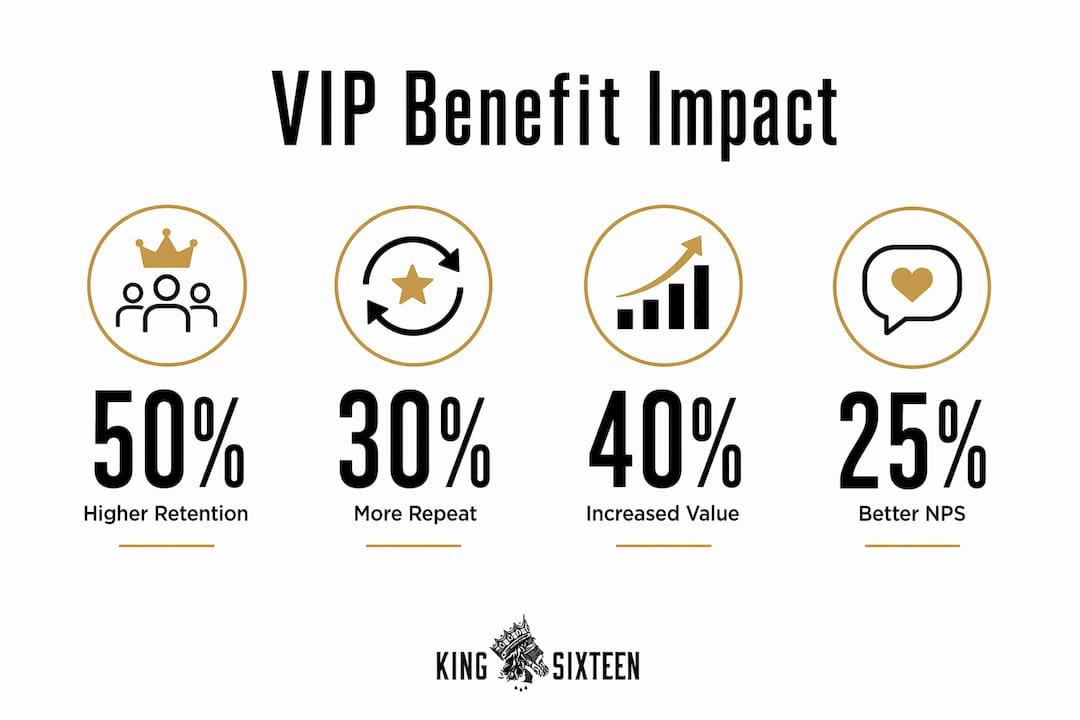
Top-tier VIP programs see 30 to 50% higher retention than non-VIP customers and show measurable growth in repeat purchase rates and lifetime value. That retention premium is the financial case for investing in experiential benefits over margin-eroding discounts.
How to operationalize and measure VIP brand experiences
Building a VIP experience that scales without losing its quality requires treating it as an operating system, not a marketing campaign. Here is a practical framework:
- Define eligibility with precision. Set clear, quantitative thresholds for VIP status based on spend, frequency, or engagement. If the bar is too low, exclusivity dilutes and the program loses its value. BIMA's research highlights that setting VIP thresholds carefully is one of the most common failure points in program design.
- Build a clienteling system. VIP clienteling systems capture structured client preferences so that personalized service survives staff turnover. This is how luxury brands like Louis Vuitton and Chanel maintain white-glove consistency at scale. The preference data lives at the brand level, not in an individual associate's memory.
- Establish entitlement and redemption rules. VIP programs must be treated as operational systems with clear identification, entitlement, and redemption rules to avoid pseudo-VIP benefits that erode trust. Document exactly what each tier receives, when, and how.
- Set measurable KPIs. Track VIP retention rate, tier progression, benefit redemption rate, and VIP customer lifetime value separately from your general customer base. These metrics reveal whether the program is delivering real differentiation or just adding cost.
- Avoid the episodic trap. Meaningful VIP experiences maintain connection before, during, and after purchase. Brands that only activate VIP treatment at events miss the ongoing relationship that drives long-term loyalty. Design a narrative arc: pre-event anticipation, in-moment excellence, and post-experience follow-through.
Pro Tip: Audit your VIP program annually against your eligibility thresholds. If more than 15% of your active customer base qualifies as VIP, the tier has lost its exclusivity signal. Tighten the criteria or add a tier above it.
The data table below summarizes the key metrics worth tracking in a mature VIP program:
| Metric | What it measures |
|---|---|
| VIP retention rate | Percentage of VIP customers who remain active year over year |
| Benefit redemption rate | Proportion of VIP benefits actually used, indicating perceived value |
| VIP lifetime value | Total revenue generated per VIP customer over their relationship with the brand |
| Tier progression rate | Speed at which customers move up through VIP tiers |
| Net Promoter Score (VIP segment) | Advocacy levels among VIP customers compared to general base |
What practical strategies and examples make VIP experiences memorable?
The brands that execute VIP experiences most effectively share one discipline: they design the full journey, not just the headline moment.
- Sephora's Beauty Insider Community is the benchmark for omnichannel VIP engagement. The program combines tiered spending rewards with a private digital community, exclusive product access, and in-store events. The community layer is what separates it from a standard points program. Members participate, share, and identify with the brand, not just its products.
- Stella Artois has used integrated brand platforms to create VIP hospitality experiences around cultural events like Wimbledon and the US Open. The brand does not just sponsor the event. It creates a curated environment within it where select guests experience the brand through food, service, and storytelling.
- Experiential marketing integration is the most powerful lever for luxury brand engagement. Private product launches, behind-the-scenes brand tours, and hosted dinners create the kind of memory that no digital campaign replicates. Explore luxury event marketing strategies to see how exclusive events translate directly into advocacy and retention.
- Social signaling without broadcasting. The most effective VIP communications feel personal, not promotional. A handwritten note, a direct message from a brand executive, or a private preview invitation carries more weight than a mass email with "VIP" in the subject line.
- The narrative arc principle. Experienced brands design VIP journeys with continuity. The pre-experience builds anticipation through personalized outreach. The in-experience delivers on the promise through operational excellence. The post-experience sustains the connection through follow-up, content, and next-step invitations.
Future-facing VIP programs are also integrating data-driven personalization at scale. AI-assisted clienteling tools now allow brands to surface preference signals and trigger personalized outreach automatically, while keeping the human touch in the delivery. The technology handles the data. The brand associate handles the relationship.
Key takeaways
A VIP brand experience succeeds when exclusivity, personalization, and operational discipline work together across every touchpoint, not just at the moment of the event.
| Point | Details |
|---|---|
| Define exclusivity precisely | Set clear, quantitative eligibility thresholds to protect the VIP tier's perceived value. |
| Prioritize experiential benefits | Early access and private events outperform discounts in driving VIP retention and advocacy. |
| Build a clienteling system | Capture client preferences at the brand level so personalized service scales without losing intimacy. |
| Measure what matters | Track VIP retention, lifetime value, and benefit redemption separately from your general customer base. |
| Design the full journey | Connect pre-experience, in-moment, and post-experience touchpoints to sustain loyalty beyond the event. |
Why VIP experience is a competitive discipline, not a campaign
I have watched brands invest heavily in a single VIP event, generate real excitement, and then lose that momentum within 60 days because nothing followed. The event was excellent. The relationship architecture was not there. That is the most common failure mode I see in VIP marketing, and it is entirely preventable.
The brands that win at VIP experience treat it the way a product manager treats a product. There is a roadmap, a governance structure, and a feedback loop. Exclusivity is managed as an operating constraint, not a creative decision made once a year. When a brand like Porsche invites a customer to a private track day, that moment is the visible tip of a much deeper system: preference data, relationship history, follow-up protocols, and next-step invitations already planned before the event ends.
What I find most undervalued in VIP strategy is the luxury brand presence that accumulates over time through consistent, small acts of recognition. A birthday acknowledgment that references a specific purchase. A product recommendation that reflects a conversation from six months ago. These moments cost relatively little to execute but carry enormous weight in how a customer perceives their relationship with the brand.
The technology question is real but often overstated. Yes, AI-assisted clienteling and omnichannel orchestration platforms make personalization more scalable. But the brands I respect most use technology to free up their people to be more human, not to replace the human interaction entirely. The goal is a system that makes every VIP customer feel like they have a dedicated relationship manager, whether or not one person is literally assigned to them.
Build the system. Protect the exclusivity. Design the journey. The emotional connection follows.
— Tyler
How King Sixteen builds VIP brand experiences that last
King Sixteen designs and executes the kind of immersive, in-person experiences that make VIP customers feel the difference immediately. From private product launches for brands like Porsche and Audi to invitation-only events that combine storytelling, environment design, and precision hospitality, we build the moments that anchor long-term loyalty. Our turnkey model covers everything: venue, fabrication, staffing, AV, catering, and digital integration, so your VIP experience is operationally flawless from first invitation to final follow-up. If you are ready to move beyond standard loyalty programs and build a VIP experience strategy that drives real retention and advocacy, we would like to show you what that looks like in practice. You can also explore our private events services to see how we approach exclusive brand moments end to end.
FAQ
What is a VIP brand experience?
A VIP brand experience is a customized, exclusive engagement designed for a brand's highest-value customers, combining personalized service, privileged access, and consistent recognition across every touchpoint. It goes beyond standard loyalty programs by treating exclusivity and personal attention as core product features.
What are the key elements of a VIP experience?
The core elements are exclusivity, personal attention, experiential benefits, and consistent brand behavior across digital, physical, and service channels. Experiential perks like early product access and private events consistently outperform discounts in driving VIP engagement and retention.
How do you measure the success of a VIP program?
Track VIP retention rate, benefit redemption rate, VIP customer lifetime value, and Net Promoter Score for the VIP segment separately from your general customer base. Top-tier VIP programs typically show 30 to 50% higher retention than non-VIP customers.
How do you maintain exclusivity in a VIP program?
Set clear, quantitative eligibility thresholds and review them annually. If too large a share of your active customer base qualifies, the tier loses its signal value and the program's credibility erodes with it.
What is the difference between VIP experience and customer experience?
Customer experience covers the full journey for all customers, while VIP brand experience is a deliberately elevated subset designed for a selected high-value segment. The VIP layer adds exclusivity, personalization depth, and experiential benefits that are not available to the general customer base.