Most luxury marketers assume that if their Instagram numbers look good, their brand engagement is healthy. That assumption is costing brands more than they realize. True brand engagement, as defined by brand engagement depth, is the depth and strength of the relationship between a brand and its audiences, encompassing emotional, cognitive, and behavioral dimensions. For high-end brands competing in a world where consumers have unlimited choices and shorter attention spans, engagement built on surface metrics is fragile. This guide will show you exactly what genuine brand engagement looks like, why it matters commercially, and how immersive experiences are the most reliable tool for building it.
Table of Contents
- Defining brand engagement: More than metrics
- How brand engagement fuels growth and loyalty
- Brand engagement vs. customer engagement: Understanding the nuance
- Experiential marketing: The innovation engine for luxury brand engagement
- Overcoming C-suite skepticism: Proving and scaling brand engagement
- Our take: What most luxury marketers miss about true brand engagement
- Elevate your brand: Experiential marketing with King Sixteen
- Frequently asked questions
Key Takeaways
| Point | Details |
|---|---|
| Beyond metrics | Brand engagement is about emotional, behavioral, and cognitive connections, not just counts of likes or shares. |
| Drives loyalty | High engagement directly fuels customer loyalty, repeat purchase, and lifetime value for luxury brands. |
| Nuanced strategy | Distinguishing brand engagement from customer engagement is key for holistic, effective marketing. |
| Experience matters | Immersive, well-designed experiential activations create lasting brand connections with high-end audiences. |
| Prove the impact | Savvy marketers blend qualitative and quantitative data to convince executives and scale engagement initiatives. |
Defining brand engagement: More than metrics
With the misconception about metrics clarified, let's break down what truly defines brand engagement.
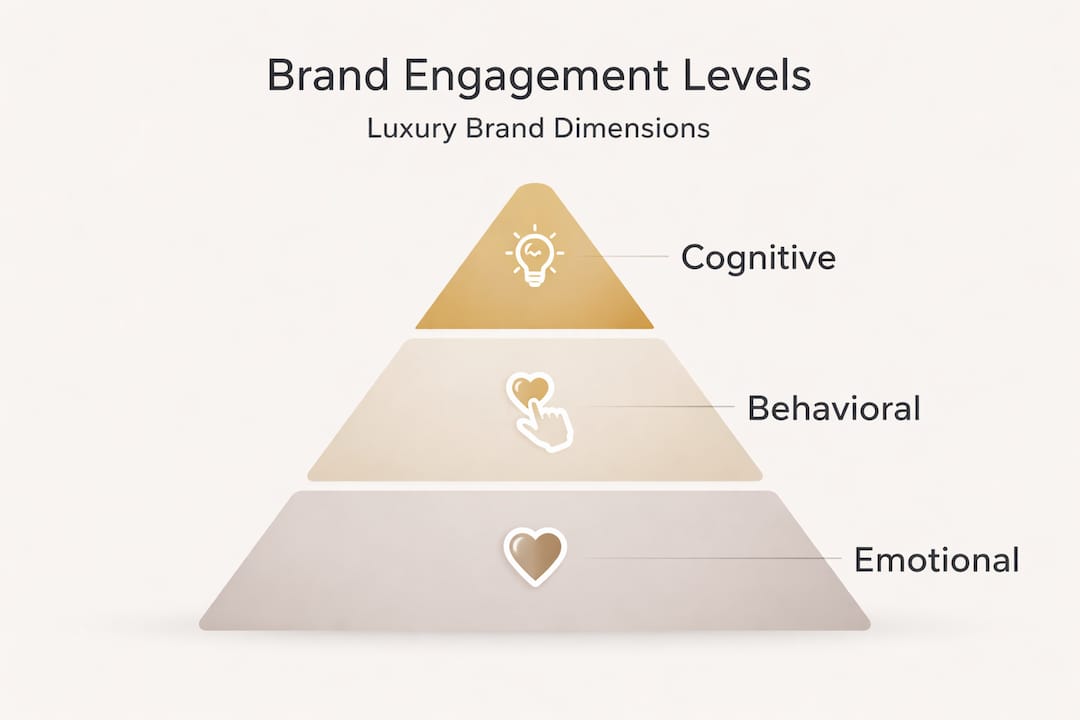
Brand engagement is not a single moment or a single channel. It is a layered relationship that develops across every interaction a customer has with your brand, from the first time they encounter your visual identity to the moment they recommend you to someone they trust. Brand engagement encompasses emotional, cognitive, and behavioral dimensions, meaning you need to earn attention, create meaning, and inspire action, all at once.
What surprises many leaders is that brand engagement includes both external engagement with customers and internal engagement with employees. Internal brand engagement shapes how your team speaks about the brand, how they deliver service, and whether your brand's values feel authentic or hollow. For luxury brands, this internal dimension is especially critical because your frontline staff often represent the experience itself.
Here is a practical breakdown of what each dimension looks like in a high-end context:
- Emotional engagement: Customers feel something when they interact with your brand. Pride, aspiration, belonging, nostalgia.
- Cognitive engagement: Customers think about your brand, associate it with specific ideas or values, and recall it vividly when making purchasing decisions.
- Behavioral engagement: Customers act. They purchase, advocate, attend events, and share experiences.
- Internal engagement: Employees live the brand, reinforcing its values through every interaction they have with the public.
| Dimension | Example for luxury brands | Why it matters |
|---|---|---|
| Emotional | Event that creates a sense of exclusivity | Builds lasting loyalty |
| Cognitive | Brand storytelling with a clear heritage | Drives preference over competitors |
| Behavioral | Repeat purchases and referrals | Converts engagement into revenue |
| Internal | Staff who are genuinely passionate advocates | Ensures consistent brand delivery |
Pro Tip: Stop measuring brand engagement purely by reach or impressions. One person who attends a curated brand experience and recommends your product to ten friends is worth far more than a thousand passive social scrollers. Prioritize the quality of interaction, not the volume.
Explore brand engagement strategies designed specifically for brands that need their audience to feel something real, not just notice them.
How brand engagement fuels growth and loyalty
Having established what brand engagement is, we can now examine the proven business value for luxury and high-end brands.
Brand engagement is not a soft metric. It is a commercial driver. Genuine brand engagement drives customer loyalty, higher lifetime value, repeat purchases, and word-of-mouth advocacy. These are the outcomes that matter to your CFO and your board, not follower counts.

For luxury brands specifically, the benchmarks are telling. Luxury brand engagement rates sit at approximately 0.75% on Instagram and 4.2% on TikTok. Customer retention in this category averages 28%, repeat purchase rates average 22%, and email open rates average 32.5%. These numbers are significantly higher than mass-market equivalents, and they reflect what happens when brands build real emotional connections rather than broad awareness.
The metrics that matter most in the luxury space include:
- Net Promoter Score (NPS): Measures how likely customers are to recommend your brand, a strong proxy for emotional loyalty.
- Customer lifetime value (CLV): Tracks the long-term revenue relationship, not just single transactions.
- Brand sentiment: Qualitative analysis of how people talk about your brand, capturing the emotional tone behind mentions and reviews.
- Repeat purchase rate: Shows whether customers are returning because of genuine attachment, not just convenience.
- Social engagement rate: The ratio of interactions to reach, measured through metrics like shares, saves, comments, and sentiment, not just likes.
The distinction between mass-market and luxury engagement also shows up in the type of actions customers take. Luxury consumers who are truly engaged share personal stories, attend exclusive events voluntarily, and defend the brand in conversations. That depth of behavior reflects a relationship, not a transaction.
For a detailed look at how engagement translates into measurable outcomes in live settings, the luxury event engagement benchmarks are worth reviewing alongside your current strategy. Combining that data with the right experiential marketing for luxury brands approach gives you a clear path from engagement investment to business results.
Brand engagement vs. customer engagement: Understanding the nuance
While growth and loyalty are compelling outcomes, there is a subtle but critical distinction to make between forms of engagement.
Brand engagement and customer engagement are not the same thing, even though they are often used interchangeably in boardrooms and briefs. Confusing them leads to misaligned strategies and wasted budget.
"Brand engagement centers on emotional and psychological connection, while customer engagement focuses on customer actions. Internal alignment is essential, and brands must use restraint in sensory design." — Shortdot Bond
Think of it this way. Customer engagement is measurable behavior: did they click the email, attend the event, complete the purchase? Brand engagement is the why behind those behaviors. It is the emotional bond that makes a customer choose you over a competitor when the price difference is significant or the convenience factor is zero.
Luxury brands need both. You need customers to act (customer engagement) and you need them to feel something deep and consistent about your brand (brand engagement). The mistake most teams make is optimizing exclusively for the behavioral actions while neglecting the emotional infrastructure underneath.
Here are three concrete steps for aligning your internal teams around holistic brand engagement:
- Audit your brand touchpoints for emotional consistency. Map every interaction a customer has with your brand, from digital ads to in-store environments to post-purchase communications. Identify where the emotional tone shifts or contradicts your brand promise.
- Align internal teams through shared brand narrative training. Your marketing team, event staff, sales team, and customer service representatives should all be able to articulate what your brand feels like, not just what it does. Regular workshops that focus on emotional brand delivery close the internal gap.
- Measure sentiment alongside behavior. Build a reporting framework that captures qualitative feedback, social sentiment, and post-event interviews alongside your standard behavioral KPIs. Sentiment data reveals the emotional layer that click-through rates cannot.
Understanding brand moments and experiential marketing is critical here. The most powerful brand moments happen when emotional engagement and behavioral action converge in the same space, and that is precisely what well-designed experiential campaigns are built to create.
Experiential marketing: The innovation engine for luxury brand engagement
Equipped with an understanding of the nuances, it is time to look at how luxury brands execute engagement through innovation.
Digital channels can reach an audience, but they rarely move one. Immersive, in-person experiences do something that no banner ad or sponsored post can replicate: they place the customer inside the brand's world. When someone stands inside a beautifully crafted brand environment, handles a product, interacts with curated sensory details, and shares that moment with people they know, the emotional imprint is profound and lasting.
The business results back this up. Experiential activations like the Oreo Wonder Vault pop-up increased social mentions by 60% and drove a 20% lift in sales. The Coach Tabby Tour, a series of immersive brand activations, contributed to 25% revenue growth. These are not soft wins. These are outcomes that justify significant investment and change how executive teams think about experiential budgets.
For high-end brands, the most effective forms of experiential marketing include:
- Immersive product launch environments: Spaces designed to tell a brand story through architecture, lighting, sound, and tactile elements.
- Exclusive VIP brand events: Private gatherings that give your highest-value customers a sense of insider access and genuine connection with the brand.
- Interactive pop-up activations: Short-run experiences that create urgency, social sharing, and direct product interaction.
- Custom fabricated brand installations: Physical brand elements, such as sculptural displays, bespoke environments, and set pieces, that communicate brand values without a single word.
- Multi-sensory brand experiences: Activations that engage sight, sound, smell, and touch to create a full emotional impression that customers carry with them long after the event ends.
Pro Tip: Resist the urge to pack every sensory detail into a single activation. Sensory overload is the enemy of emotional resonance. Choose two or three signature brand elements and execute them with precision. The memory you want to leave is specific and vivid, not overwhelming.
For inspiration on what these activations look like in practice, brand activation case studies show the range of outcomes possible across different industries and formats. If you are building from scratch, the guide to brand activations is a strong starting point, and the strategies for high-end experiential marketing will help you tailor the approach to your audience.
Overcoming C-suite skepticism: Proving and scaling brand engagement
Even with evidence of results, luxury marketers must often champion the value of engagement to executive teams seeking measurable ROI.
This is one of the most common and frustrating realities in high-end marketing. You know the experience worked. The room was electric, the feedback was exceptional, and the social content was extraordinary. But when the CFO asks for the revenue attribution, the conversation gets complicated.
The data does not make it easier. Only 69% of CMOs believe in the long-term value of brand engagement, down from 80% in previous years. That erosion of confidence reflects the pressure CMOs face to deliver short-term, attributable results in a measurement environment that was built for performance marketing, not relationship-building.
The answer is not to abandon brand engagement. It is to build a measurement framework that speaks the language of the boardroom while capturing the full picture.
Here is a practical step-by-step approach:
- Set engagement baselines before the campaign. Capture current NPS scores, sentiment data, retention rates, and CLV before you launch any experiential activity. This gives you a clean before-and-after comparison.
- Define leading indicators tied to business outcomes. For example, if repeat purchase rate is a key business goal, track event attendees versus non-attendees over a 90-day period. Real behavior data is far more persuasive than impressions.
- Collect qualitative data at scale. Post-event surveys, short-form video testimonials, and structured one-on-one conversations with attendees give you the emotional story that numbers cannot tell on their own.
- Report in two layers. Present the quantitative data first for the CFO audience, then layer in the qualitative brand sentiment story for the CEO and brand team. Different stakeholders need different narratives from the same results.
Pro Tip: Build a simple one-page engagement scorecard that shows five metrics: NPS movement, retention delta, repeat purchase rate, sentiment shift, and earned media value from the activation. That single-page view makes a powerful case without overwhelming your executive audience with methodology.
For brands thinking long-term, lasting brand presence strategies provide a framework for scaling engagement investment in a way that compounds over time rather than delivering one-off spikes.
Our take: What most luxury marketers miss about true brand engagement
After exploring the strategies, data, and real-world cases, let us address what even sophisticated luxury marketers often overlook.
The most common mistake we see is brands investing in engagement tactics without an engagement philosophy. They execute a stunning event, generate significant buzz, and then return to business as usual. The event becomes an island, disconnected from the broader brand relationship. Six months later, the lift in sentiment has faded and the team is back to debating social content calendars.
True brand engagement is not a campaign. It is a continuous posture. It requires that every touchpoint, whether a product launch, a customer service call, an in-store interaction, or a social post, reinforces the same emotional promise. That level of consistency is hard work. It demands internal alignment that most organizations underinvest in, and it requires leadership that values long-term relationship-building over short-term performance metrics.
The brands we have worked with that do this exceptionally well share one trait: they treat the customer's emotional journey as a design problem. They ask, "How do we want this person to feel at every stage of their relationship with us?" and then they reverse-engineer every touchpoint from that answer. That approach is what separates brands that generate engagement from brands that are engaging.
We also believe that the obsession with digital measurement has inadvertently devalued the most powerful engagement tool available: physical presence. When someone walks into a world you have built for them, that experience registers in a way that no algorithm can replicate or replace. The data from luxury experiential engagement insights consistently confirms this. The brands willing to invest in immersive physical experiences are the ones building engagement that outlasts any single campaign.
Elevate your brand: Experiential marketing with King Sixteen
Ready to move from theory to transformative experiences? Here is how to unlock new levels of brand engagement for your organization.
At King Sixteen, we design and execute immersive, in-person experiences for high-end brands that need more than attention. Our clients, including Porsche, Audi, Ray-Ban, and the Natural Diamonds Council, trust us to build brand environments that create real emotional connection and drive measurable outcomes. From product launches to custom fabricated installations, we manage every detail through a turnkey model that removes execution risk and maximizes impact.
If you are ready to build brand engagement that resonates far beyond a single activation, explore our experiential marketing solutions and see how we approach strategy, design, and execution for brands that cannot afford to be forgettable. Visit King Sixteen to start the conversation and bring your brand's next immersive experience to life.
Frequently asked questions
What is brand engagement in simple terms?
Brand engagement is the emotional and psychological connection people have with a brand, not just their interactions or transactions. As defined by engagement depth and strength, it encompasses emotional, cognitive, and behavioral dimensions across all touchpoints.
How can luxury brands measure brand engagement?
Luxury brands should track a combination of social engagement rates, customer retention, repeat purchase rate, email open rates, and Net Promoter Score. These key engagement metrics together paint a full picture of the relationship, not just surface behavior.
What makes experiential marketing effective for luxury brands?
Experiential marketing creates deep emotional resonance that digital channels alone cannot achieve, translating directly into advocacy and revenue. Experiential activations like the Coach Tabby Tour have demonstrated 25% revenue growth tied specifically to in-person brand experiences.
What is the difference between brand engagement and brand awareness?
Brand awareness means your audience recognizes your name or logo, while brand engagement means they have formed a genuine emotional and psychological connection that drives loyalty and action. Brand engagement depth goes far beyond recognition, encompassing the full relationship between brand and audience.