Most marketing budgets are built around what people can see. That's a problem, because multi-sensory experiences increase brand memorability by up to 70% compared to visual-only cues in physical activations. For heads of marketing and event directors at established brands, that gap between what you're investing in and what actually drives recall is where your competitors are quietly gaining ground. Sensory brand activation, the practice of engaging multiple human senses simultaneously to deepen brand connection, is no longer a novelty tactic. It's a measurable business tool, and this article breaks down exactly how to use it.
Table of Contents
- What is sensory brand activation and why it matters
- Key sensory channels and their strategic roles for luxury brands
- Proven business impact and ROI from sensory brand activations
- Designing effective sensory brand activations: strategy and best practices
- Integrating sensory activations into holistic brand experiences
- Why subtlety and consistency define sensory success for luxury brands
- Elevate your brand experience with King Sixteen expert activations
- Frequently asked questions
Key Takeaways
| Point | Details |
|---|---|
| Memorability boost | Multi-sensory brand activations increase memorability by up to 70% compared to visual-only branding. |
| Strategic sense selection | Prioritize 1-2 senses aligned with your brand to create authentic, consistent experiences without overwhelming audiences. |
| Proven ROI | Brands like McDonald’s and BMW have demonstrated measurable sales lifts and conversion rate improvements through sensory activations. |
| Holistic integration | Effective activations combine sensory, emotional, intellectual, and behavioral dimensions for powerful consumer engagement. |
| Measurement beyond basics | Track dwell time, consumer sentiment, and neurological recall to accurately assess sensory activation success. |
What is sensory brand activation and why it matters
Sensory brand activation is the intentional design of brand experiences that engage more than just sight. It pulls in sound, smell, touch, and sometimes taste to create encounters that register on an emotional and neurological level. Think of it as the difference between a customer seeing your logo on a banner and feeling your brand through the temperature of a room, the texture of a product surface, and a scent that they'll associate with you for years.
For luxury brands specifically, this matters more than it does for mass-market players. Your audience has seen it all. They've attended the polished events, handled the premium packaging, and scrolled past the high-production photography. What they haven't experienced enough is a brand that makes them feel something before they've consciously decided to trust it. That's what a well-executed brand activation guide built on sensory principles delivers.
The common misconception is that strong visual identity is enough. It isn't, and the neuroscience is clear on this. Sensory inputs processed through smell, sound, and touch bypass rational evaluation entirely and go straight to memory and emotion centers. That's not a soft benefit. That's architecture for preference.
Here's what sensory brand activation actually encompasses:
- Sight: Lighting design, color temperature, spatial layout, and material choices that tell your brand story without a single word
- Sound: Curated playlists, ambient noise control, sonic logos, and live acoustic design that set emotional tone
- Smell: Signature scents deployed at the entrance, on printed materials, or through HVAC systems to anchor memory
- Touch: Surface textures, fabric weight, temperature, and physical resistance that signal quality before a product is even evaluated
- Taste: Food and beverage programming that reflects your brand's values, provenance, or personality
Multi-sensory experience design is not about overwhelming the room with stimuli. It's about selecting the right combination and executing it with precision.
Key sensory channels and their strategic roles for luxury brands
Each sense plays a distinct role in how your audience perceives and remembers your brand. Understanding those roles lets you allocate budget and attention to the channels that will move the needle most for your specific brand personality.
Sight is your baseline. Lighting alone can shift perception of a space from transactional to experiential. Warm, directional light signals intimacy and prestige. Harsh, even light reads as functional. Beyond lighting, consider what materials dominate the room. Matte finishes read as understated luxury. High gloss reads as energy and modernity. Every visual choice communicates before anyone speaks.
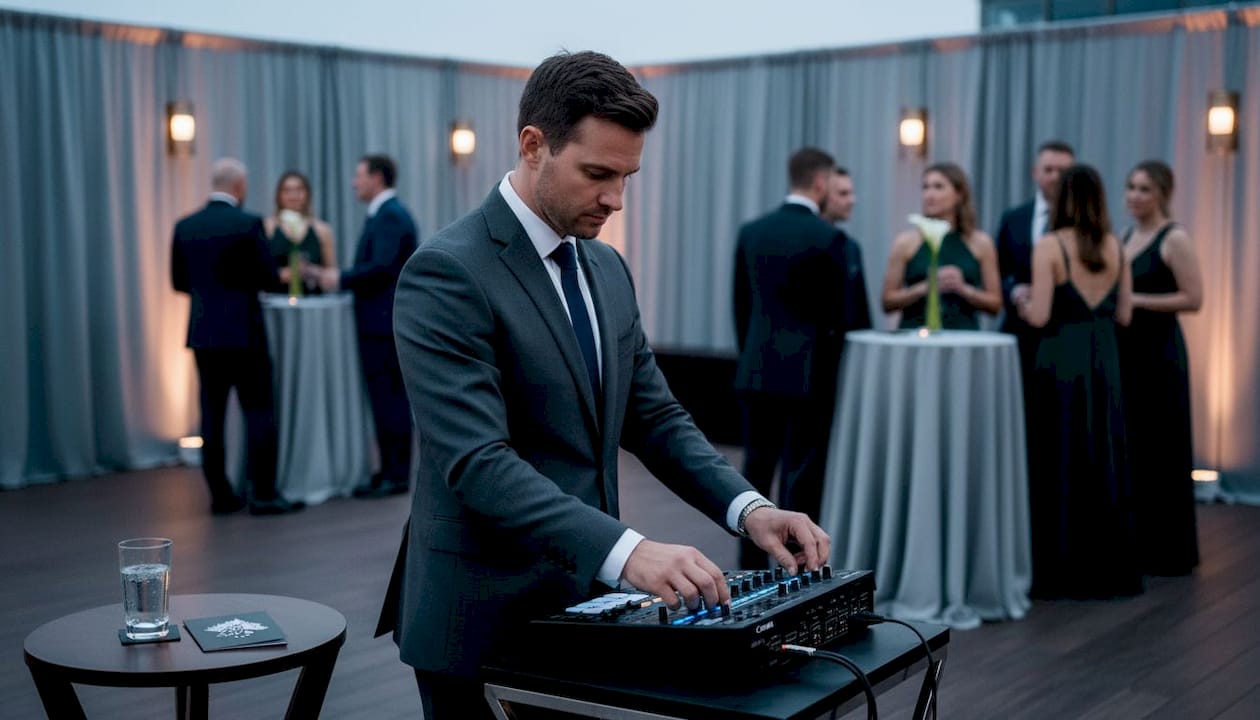
Sound is wildly underutilized at the high-end level. Most luxury events default to generic background music chosen from a Spotify playlist. The brands doing this right have developed sonic identities, specific tempo ranges, instrumentation palettes, and even custom compositions that become auditory signatures. When creating immersive activations, sound is often the fastest lever to pull because it changes the entire emotional register of a space in seconds.
Smell is arguably the most powerful and the most neglected. The olfactory bulb is directly wired to the brain's limbic system, making signature scents a subconscious trigger for emotion and memory in physical spaces. A guest who encounters your brand scent six months later at an airport hotel will feel an emotional pull toward your brand without knowing why. That is retention money can't buy through advertising.
Touch does something the other senses can't: it communicates quality claims without requiring any copy. The weight of a gift bag, the grain of a tablecloth, the smoothness of a product's surface all speak directly to your positioning. In brand environment design, tactile choices are often the detail that separates a premium activation from one that feels like it was produced from a template.
Taste is the most resource-intensive but also the most socially potent. Food and beverage programming at activations creates shared rituals, dwell time, and conversation. For brands with a strong provenance story, taste is a vehicle for that narrative.
| Sensory element | Luxury spa example | Modern co-working space example |
|---|---|---|
| Sight | Candlelight, natural stone, muted earth tones | Crisp white, exposed concrete, bold accent walls |
| Sound | Low-frequency ambient tones, silence zones | Energetic lo-fi playlists, subtle white noise |
| Smell | Eucalyptus, sandalwood, warm vanilla | Fresh linen, subtle citrus, clean air systems |
| Touch | Heated stone surfaces, thick towels, soft robes | Ergonomic textures, cool metal hardware |
| Taste | Herbal teas, infused water, minimal plating | Cold brew, protein bars, grab-and-go formats |
Pro Tip: Before your next activation, run a 15-minute sensory audit of your venue. Walk through it with your eyes closed for 30 seconds. What you hear and smell in those 30 seconds is what your guests will unconsciously register first.
Proven business impact and ROI from sensory brand activations
If you need to defend sensory activation investment to a CFO, the data is on your side. These aren't soft metrics.
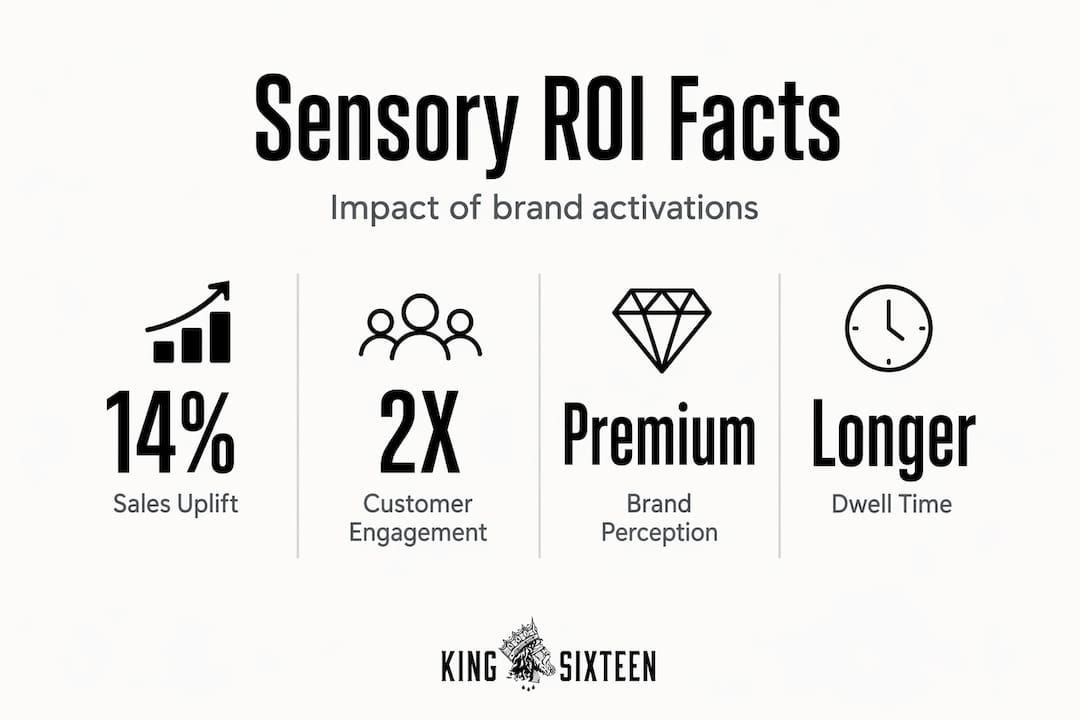
McDonald's restaurants near scented billboards saw a 14% increase in sales during the campaign period. This was achieved by deploying scent diffusers on outdoor advertising near locations, triggering appetite cues before customers even entered. The mechanism is simple, the result is commercial.
BMW's sensory showroom activations achieved 23% higher prospect conversion rates, adding approximately £85,000 monthly revenue per showroom. Their approach involved curated ambient sound, lighting temperature adjustments based on time of day, and scent profiles tied to specific model lines. The conversion lift wasn't incidental. It was documented and repeatable.
| Brand | Sensory strategy | Measurable outcome |
|---|---|---|
| McDonald's | Outdoor scent marketing near locations | 14% sales increase |
| BMW | Multi-sensory showroom design | 23% conversion rate increase |
| Luxury retail (broad) | Signature in-store scent programs | Extended dwell time and higher basket values |
- Customers spend more time in scented environments, which directly correlates with higher spend per visit
- Consistent sensory environments reinforce perceived quality, making premium pricing feel justified rather than questioned
- Brands that deploy experiential marketing with sensory layers see stronger recall in post-event surveys than those relying on visual-only presentations
"Sensory brand activations aren't just about creating a nice atmosphere. They're about engineering the conditions under which a customer decides to trust you. That decision happens emotionally, not rationally, and you need to design for it accordingly."
The pattern across the data is consistent: sensory activations justify premium positioning, extend customer engagement, and deliver conversion improvements that visual-only environments simply cannot match.
Designing effective sensory brand activations: strategy and best practices
The difference between a sensory activation that moves people and one that costs money without clear return almost always comes down to how it was planned. Good intentions without a framework produce noise. A clear framework produces brand equity.
Practitioners advise auditing touchpoints first, prioritizing 1-2 senses aligned with brand adjectives, and creating consistent assets like sonic logos to avoid inconsistency pitfalls. That advice holds up in practice. The brands that try to activate all five senses simultaneously in their first activation almost always overdeliver on production complexity and underdeliver on coherence.
Here's a practical framework we recommend:
- Audit every touchpoint. Map your customer's physical journey through your activation from arrival to departure. Identify what they see, hear, smell, touch, and potentially taste at each stage. Most brands find at least three moments where a sensory element is absent or accidental.
- Select your primary senses. Based on your brand personality and your audience profile, choose 1-2 senses to lead with. A heritage spirits brand might lead with smell and touch. A tech-forward automotive brand might prioritize sound and sight.
- Develop repeatable sensory assets. A sonic logo, a signature scent formula, or a specific lighting temperature specification becomes an asset you can deploy across events, retail, and even digital content. Consistency is what converts a single activation into a recognizable brand experience.
- Design for subtlety. The goal is reinforcement, not announcement. Your scent should make guests feel comfortable and warm, not turn their heads and make them wonder what they're smelling.
- Build your measurement system before launch. Measuring sensory activations requires tracking dwell time, post-experience sentiment, and neurological indicators like recall rates beyond traditional KPIs for true ROI assessment. Set those baselines in advance so you have something to measure against.
- Evaluate and iterate. After the activation, gather qualitative data through exit interviews and quantitative data through dwell metrics. Use those findings to refine sensory choices for the next execution.
Pro Tip: If you're building a sensory activation for the first time, test your scent and sound choices on a small internal group before the event. What feels right in a design meeting can feel overpowering in a room full of people.
Your step-by-step brand activation planning process should integrate sensory decisions at the same stage as venue selection and content development, not as a last-minute production detail.
Integrating sensory activations into holistic brand experiences
A sensory activation that operates in isolation from the rest of your brand experience is a missed opportunity. The real power comes when sensory design reinforces what your audience is thinking, feeling, and doing throughout the experience.
Activating the four dimensions of brand experience — sensorial, emotional, intellectual, and behavioral — predicts consumer behavior with over 75% accuracy, which makes integrated sensory strategies not just a creative preference but a commercial priority. The four dimensions work together:
- Sensorial: What the environment feels, sounds, smells, and looks like
- Emotional: The feelings and associations the experience generates
- Intellectual: The ideas and curiosity the experience provokes
- Behavioral: The actions the experience motivates, from purchases to shares to referrals
Most activations nail one or two of these and leave the others to chance. When your environmental branding strategies are designed to address all four, you're not just producing an event. You're producing a decision-making environment.
Successful sensory activations start with a clear narrative and purpose, ensuring all senses serve measurable goals like brand awareness. The narrative is the spine. Every sensory element should attach to it.
| Dimension | Role in activation | Practical example |
|---|---|---|
| Sensorial | Creates the physical experience | Signature scent at entrance, curated playlist |
| Emotional | Generates feeling and memory | Story-driven content, lighting that creates warmth |
| Intellectual | Sparks curiosity and engagement | Interactive displays, product demos, expert conversations |
| Behavioral | Drives action | Clear conversion moments, shareable photo opportunities |
Pro Tip: Align your behavioral prompts with your sensory cues. If your scent and sound choices are designed to create calm and trust, don't immediately follow with a high-pressure sales interaction. Brand friction happens when your sensory environment promises one experience and your process delivers another.
Why subtlety and consistency define sensory success for luxury brands
Here's the perspective most sensory marketing content misses: more is almost always less at the high end.
We've seen activations where every sense is activated simultaneously, where there's a signature scent, a live DJ, an interactive texture wall, a chef station, and a light installation all competing for attention. The result isn't immersion. It's noise. And noise is the opposite of luxury.
Insiders warn against overstimulating with all five senses. The guidance is to focus on subtle integration where elements reinforce the narrative and test for personalization to prevent what practitioners call noise pollution. That warning is earned. The most memorable activations we've been part of, including those built for Porsche and Audi, weren't the loudest or the most technically complex. They were the most coherent. Every element served the story, and nothing competed with anything else.
Consistency over time matters just as much as quality in the moment. A signature scent means nothing if it shows up at one event and disappears for the next 12 months. A sonic identity only builds recognition through repetition. The brands that get the most from sensory investment are the ones that treat it like brand standards, with documentation, guidelines, and quality control built into every production.
Emerging trends worth watching: adaptive sensory environments that respond to guest behavior in real time, and personalized scent profiles tied to different stages of the customer journey. These are early-stage but directionally important. The brands building immersive brand activations that last are already prototyping them.
The principle underneath all of it is simple: your sensory choices should make people feel something specific, not everything at once. Define the feeling first. Build backward from there.
Elevate your brand experience with King Sixteen expert activations
Knowing the framework for sensory brand activation is one thing. Executing it at the level your brand demands is another. That's where we come in.
At King Sixteen, we design and produce immersive sensory experiences for established brands that need to be felt, not just seen. From curated soundscapes and signature scent integration to custom-fabricated environments built around your brand narrative, we handle every element under one roof. Our work with brands like Porsche, Audi, and the Natural Diamonds Council demonstrates what happens when sensory strategy meets production discipline. Whether you're planning a high-impact vehicle launch or a private brand activation, we bring the creative precision and logistical control to make every sensory detail count.
Frequently asked questions
What exactly is sensory brand activation?
Sensory brand activation uses multiple senses like sight, sound, and smell to create immersive experiences that deepen emotional connections between customers and brands. Multi-sensory experiences increase brand memorability by up to 70% compared to visual-only cues.
Which senses should luxury brands prioritize in activations?
Focus on 1-2 core senses aligned with your brand values, such as a subtle signature scent or a curated soundscape, to maintain coherence and avoid overwhelming guests. Practitioners advise prioritizing 1-2 senses aligned with brand adjectives and creating consistent assets like sonic logos to avoid inconsistency pitfalls.
How do sensory activations impact sales and ROI?
The commercial results are well-documented: McDonald's saw a 14% sales increase near scented billboards, while BMW achieved 23% higher conversion rates through multi-sensory showroom activations.
How can sensory activations be measured effectively?
Measuring sensory activations requires tracking customer dwell time, gathering post-experience sentiment through surveys, and evaluating neurological indicators like recall rates, all of which go beyond traditional event KPIs.
What are common pitfalls to avoid in sensory brand activations?
The biggest risk is overstimulation. Insiders warn against activating all five senses simultaneously and advise focusing on subtle integration where every element reinforces the brand narrative rather than competing with it.